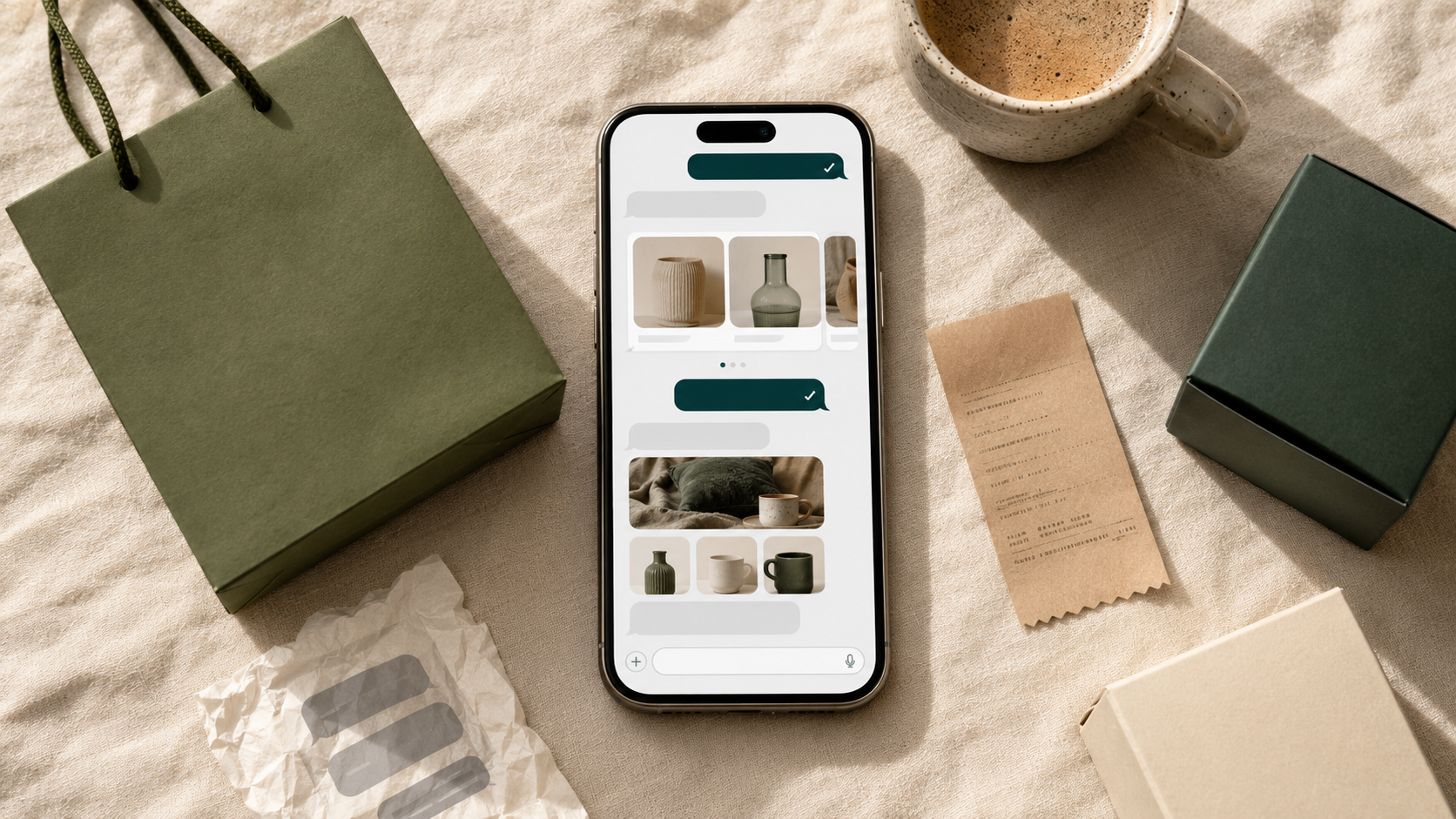
Hot take: RCS is the biggest upgrade to text messaging since... well, since text messaging. Product carousels inside your customer's inbox. Tap-to-buy buttons. Verified brand logos instead of random phone numbers. It sounds like the future of SMS marketing for Shopify stores. And honestly? It kind of is. But here's what nobody selling you an RCS platform will tell you: a prettier message doesn't fix a bad conversation. Your abandoned cart recovery still needs a real human on the other end.
If you've been running SMS campaigns for your Shopify store, you've been working with technology from 1992. Literally. SMS (Short Message Service) was designed in the early '90s, and its core spec hasn't meaningfully changed since. 160 characters. Plain text. No read receipts. No typing indicators. No way to verify who's actually sending the message.
RCS (Rich Communication Services) changes all of that. It's the protocol upgrade that turns your customers' default messaging app into something that looks and feels like iMessage or WhatsApp, but works natively on every phone. And as of 2026, with Apple finally supporting RCS on iOS 18 and 3.8 billion projected RCS users globally, this isn't a "coming soon" story anymore. It's here.
For Shopify merchants spending real money on SMS marketing, understanding RCS isn't optional. It's the difference between your messages looking like everyone else's plain-text blasts and standing out with rich, interactive experiences that actually convert. Let's break down what matters.
What Is RCS and Why Should Shopify Merchants Care?
RCS is a messaging protocol that replaces SMS with richer, app-like experiences inside the native messaging app on your customer's phone. No separate app download. No opt-in to a new platform. It just works in the same place they already text.
Here's what RCS brings to the table that SMS can't touch:
- Rich media. High-resolution images, videos, GIFs, and product carousels, all rendered beautifully inside the message thread. No more linking out to a webpage just to show a product photo.
- Interactive buttons. "Buy Now," "View Cart," "Track Order." Tap-to-action buttons that let customers take the next step without leaving the conversation.
- Verified sender profiles. Your brand name, logo, and a verification badge show up instead of a random 10-digit number. Customers know exactly who's texting them.
- Read receipts and typing indicators. You can see when a customer reads your message and they can see when you're typing back. Real conversation cues.
- No character limits. SMS caps you at 160 characters (or 70 for non-Latin scripts). RCS has no practical limit. Write what you need to write.
- File sharing. Send PDFs, receipts, return labels, up to 100MB per file, directly in the message thread.
For Shopify merchants, the practical impact is immediate. Your abandoned cart message can include an actual image of the product they left behind, a "Complete Purchase" button that takes them straight to checkout, and your verified brand identity so they trust it's really you. That's a different universe from "Hey! You left something in your cart. Click here: [link]."
The Numbers: RCS Performance vs. SMS and Email
The conversion data on RCS is still early (most brands are in the experimentation phase), but what's coming in is hard to ignore.
| Metric | SMS | RCS | |
|---|---|---|---|
| Open rate | 20-25% | 98% | 90% within 15 min |
| Click-through rate | 2-3% | 19-36% | 3-7x higher than SMS |
| Conversion lift | Baseline | 2-3x vs email | Up to 20% higher than SMS |
| Avg. engagement time | 8-10 seconds | ~3 seconds | Up to 45 seconds |
| Cart recovery rate | 5-10% | 10-15% (automated) | Higher (early data) |
That engagement time number is the one to watch. Customers spend up to 45 seconds interacting with RCS content, compared to about 3 seconds scanning a plain SMS. That's 15x more attention on your message. When you're trying to recover a $150 abandoned cart, those extra seconds of engagement are worth real money.
Early adopters are seeing results. Businesses running RCS campaigns report conversion boosts of up to 20% over equivalent SMS campaigns. And customers are 35 times more likely to open an RCS message than an email. Those aren't incremental improvements. That's a different game.
Apple Said Yes: Why 2026 Is the RCS Tipping Point
For years, the biggest barrier to RCS adoption was Apple. Google pushed RCS on Android starting in 2019, but Apple stuck with SMS for cross-platform messaging, which meant any message sent to an iPhone from an Android (or from a business RCS platform) would fall back to plain SMS. Half your audience couldn't see your rich content.
That changed with iOS 18 in September 2024. Apple added RCS support to the default Messages app, and by iOS 18.4 (March 2025), all major U.S. carriers (Verizon, AT&T, T-Mobile) supported RCS on iPhone. As of May 2026, end-to-end encrypted RCS is in beta testing on iOS 26.5 in the U.S. and Canada, built on the GSMA's Universal Profile 3.0.
What this means for Shopify merchants: RCS is no longer an "Android-only" play. Your entire customer base, iPhone and Android, can receive rich messages. The addressable market just went from roughly half your list to nearly all of it.
With 3.8 billion projected RCS users globally in 2026, the reach argument is settled. The question now is how you use it.
How to Use RCS for Your Shopify Store (Right Now)
RCS isn't a "wait and see" technology anymore. Here's how Shopify merchants are using it today:
1. Abandoned Cart Recovery
This is the obvious one, and the highest-ROI use case. Instead of a plain text saying "You left something behind," an RCS cart recovery message includes:
- A product image carousel showing exactly what they left in their cart
- Current pricing and any active promotions
- A "Complete Purchase" button linking directly to their pre-filled checkout
- Your verified brand identity (logo + name + checkmark)
The visual reminder triggers purchase intent in a way text alone can't. Customers remember what they wanted when they can see it again.
2. Order Confirmations and Shipping Updates
Rich order confirmation messages with product images, estimated delivery dates, and a "Track Package" button. No more sending customers to a separate tracking page. The whole experience lives in their message thread.
3. Product Launches and Promotions
Launch a new product with a hero image, a short description, pricing, and a "Shop Now" button, all in a single message. Compare that to a plain-text SMS with a shortened URL and no preview. The difference in click-through is exactly what you'd expect.
4. Post-Purchase Engagement
Send review requests with star-rating buttons customers can tap inline. Recommend complementary products with carousels. Share care instructions or how-to-use videos directly in the thread.
5. Customer Support
RCS typing indicators and read receipts make support conversations feel more natural. Customers can share photos of damaged items directly in the chat. Agents (or bots) can respond with image-based troubleshooting guides.
RCS + SMS Fallback: You Don't Have to Choose
Here's the practical reality that makes RCS low-risk for Shopify merchants: every RCS platform includes automatic SMS fallback. If a customer's device or carrier doesn't support RCS, your message is delivered as a standard SMS instead. No action required on your end.
This means you can start sending RCS messages today without worrying about reach. Your RCS-capable customers get the rich experience. Everyone else gets the same SMS they would have received anyway. Zero downside.
Most platforms handle this transparently. You compose one message with rich content, and the platform delivers it as RCS or SMS based on each recipient's capability. The fallback is automatic.
Who's Already Offering RCS for Shopify?
The major SMS marketing platforms for Shopify are rolling out RCS support at different speeds:
- Klaviyo announced in Spring 2026 that its next-best-product (NBP) recommendations now work in SMS, RCS, and WhatsApp. If you're already on Klaviyo, RCS is becoming part of your existing flows.
- Attentive has been expanding its RCS capabilities and has early adopters like FragranceNet.com running 30+ RCS campaigns with consistent lifts in engagement and conversion.
- Postscript, Omnisend, and EZ Texting all offer Shopify integrations with varying levels of RCS support.
The ecosystem is moving fast. If your current SMS platform doesn't have an RCS roadmap, it's time to ask why.
The Catch: RCS Still Can't Replace a Real Conversation
Now here's the part that the RCS hype machine leaves out.
RCS makes your messages look better. Richer media. Prettier buttons. Verified branding. All of that is genuinely useful. But it doesn't change the fundamental dynamic of who (or what) is on the other end of the conversation.
An automated RCS message with a product carousel and a "Buy Now" button is still an automated message. It's a fancier version of "Did you forget something?" And for a lot of your customers, especially the ones abandoning high-value carts, that's not enough.
Think about what actually brings a hesitant customer back:
- "I'm not sure about the sizing." A real agent shares their personal experience with the product or connects them with size-specific advice.
- "I found it cheaper somewhere else." A human can have a genuine conversation about value, quality, and what makes your brand different. A carousel can't.
- "I need it by Friday." An agent checks shipping options in real time and gives a straight answer. A bot serves a generic "shipping info" link.
79% of consumers prefer talking to a real person over AI, according to a 2026 SurveyMonkey study. RCS doesn't change that preference. It just makes the delivery mechanism prettier.
The brands seeing the best results are combining RCS's visual advantages with human-powered conversations. Use RCS to send that beautiful product carousel as the initial touch. Then when a customer replies, have a real person respond. The rich media gets attention. The human conversation closes the sale.
RCS vs. SMS vs. Email: Which Channel When?
Smart Shopify merchants aren't picking one channel. They're layering them. Here's the framework:
| Use Case | Best Channel | Why |
|---|---|---|
| Cart recovery (first touch) | RCS (SMS fallback) | Product images + buy buttons get attention fast |
| Cart recovery (follow-up) | Human SMS | Real conversation handles objections |
| Order confirmation | RCS | Rich media + tracking buttons |
| Flash sales / promotions | RCS | Product carousels + tap-to-buy |
| Win-back campaigns | Email + SMS | Longer content + follow-up nudge |
| Product education | Long-form content, embedded video | |
| Customer support | RCS or Human SMS | Real-time with media sharing |
| Review requests | RCS | Inline star-rating buttons |
Notice the pattern: RCS wins on visual, transactional messages. Human SMS wins when the conversation matters more than the presentation. Email wins when you need space. The best recovery strategies use all three.
Getting Started with RCS on Shopify: A Quick Checklist
If you're ready to start testing RCS for your Shopify store, here's your checklist:
- Check your SMS platform's RCS support. Ask your current provider (Klaviyo, Attentive, Postscript, etc.) about their RCS roadmap. If they don't have one, evaluate alternatives.
- Start with cart recovery. This is the highest-ROI use case and the easiest to measure. A/B test an RCS abandoned cart message against your current SMS flow.
- Design for the carousel. Your product images need to look great at messaging-app dimensions. If your product photography is weak, fix that before investing in RCS.
- Set up SMS fallback. Make sure your platform automatically delivers SMS to devices that don't support RCS. This should be default, but verify it.
- Don't abandon human follow-up. RCS is the attention-getter. A real conversation is the closer. Use both.
- Monitor your metrics separately. Track RCS open rates, engagement time, and conversion rates independently from SMS so you can see the actual lift.
FAQ
What is RCS messaging?
RCS (Rich Communication Services) is an upgrade to traditional SMS that enables rich media, interactive buttons, verified sender branding, read receipts, and typing indicators inside your customer's native messaging app. Think of it as iMessage-quality messaging that works across both iPhone and Android.
Does RCS work on iPhone?
Yes. Apple added RCS support in iOS 18 (September 2024), and all major U.S. carriers now support RCS on iPhone. As of May 2026, end-to-end encrypted RCS is in beta. Your messages reach both Android and iPhone users.
Is RCS better than SMS for Shopify cart recovery?
For the initial abandoned cart message, yes. RCS lets you include product images, pricing, and a direct checkout button, all inside the message. Early data shows up to 20% higher conversion over plain SMS. But for follow-up conversations where customers have questions or objections, human-powered SMS still outperforms because a prettier message doesn't replace a real conversation.
Do I need a separate app for RCS?
No. RCS works inside the default messaging app on your customer's phone (Google Messages on Android, Messages on iPhone). There's nothing for your customers to download or opt into beyond their existing SMS subscription.
What happens if my customer's phone doesn't support RCS?
Your message automatically falls back to standard SMS. Every RCS platform handles this transparently. Your customer gets the message either way. There's zero risk of messages not being delivered because of RCS compatibility issues.
RCS is genuinely exciting for Shopify merchants. Richer messages, better engagement, and a native experience that makes your brand look professional instead of spammy. But remember: the medium is only as good as the message. And the message is only as good as the conversation behind it. The smartest play? Use RCS to grab attention, then let real humans close the deal. See how LiveRecover combines human-powered recovery with SMS for Shopify stores.